Indoor Birthday Party Games That Fit the Age and the Clock
Most indoor birthday parties run for about two hours, and the games have to fill maybe half of that. The problem is rarely a shortage of ideas. It is that a game written for nine year olds falls apart with four year olds, and a game that looks like it will last twenty minutes is finished in four. This page groups games by age band and gives each one a running time based on how long it holds attention rather than how long the rules take to read.
Quick answer
The best indoor birthday party games are the ones matched to the guests' age and to the time you have left in the schedule. For ages three to five, use short circle games of five to ten minutes. For six to nine, use team games of ten to fifteen minutes. For ten and up, use games with a scoring system that can run fifteen to twenty minutes without losing attention.
Key takeaways
- Plan roughly one game per fifteen minutes of party time, not back to back.
- Younger guests need shorter rounds and clear turn order.
- Keep two spare games in reserve for when something ends early.
- Clear a single play zone rather than using the whole house.
- End with a calm game before cake so the room settles.
How to build the schedule before you pick the games
Write the fixed points down first: arrival, food, cake, presents, pickup. What remains is your game budget. A two hour party usually leaves about forty five minutes of genuine play once you account for the slow start as guests trickle in and the long tail of goodbyes. Divide that into blocks and choose games to fit the blocks rather than choosing games and hoping they fit.
Order matters as much as selection. Open with something that works with a partial group, because half the guests will arrive late. Put the loudest game in the middle. Put something seated and quiet directly before cake, so the room is not at full volume when candles appear.
| Time | What happens | Notes |
|---|---|---|
| 0-15 min | Arrivals and a drop-in game | Must work with any number of players |
| 15-40 min | Two active games | Highest energy of the party |
| 40-55 min | Food | Games stop entirely |
| 55-75 min | One team game | Re-starts the energy after eating |
| 75-90 min | Seated game, then cake | Deliberately calm |
| 90-120 min | Free play and pickup | No structure needed |
A workable two hour running order
Ages 3 to 5: short rounds, clear turns
At this age the rules need to fit in one sentence and every child needs to see their turn coming. Anything involving elimination causes more trouble than it is worth, so keep everyone in for the whole game.
Sleeping Lions (5 minutes)
Everyone lies on the floor and stays as still as possible. One or two adults walk around trying to make them move by talking, pulling faces or telling a silly story, but never touching. Anyone who moves gets up and joins the side making others move. The last one lying still wins. It is the single most useful game on this list because it lowers the volume of a room in under a minute.
Colour Corners (8 minutes)
Tape a different coloured sheet of paper in each corner of the room. Play music while the children move around. When it stops, everyone runs to a corner. Draw a colour from a bag and the children in that corner take a bow and everyone claps. Draw again for the next round. Nobody is out, so it can run for as long as it holds interest.
Feed the Monster (10 minutes)
Cut a large mouth in the side of a cardboard box and draw a face around it. Children take turns throwing rolled-up socks into the mouth from a line on the floor. Move the line back one step each round. Count the total as a group score rather than tracking individuals, and try to beat it on a second run.
Ages 6 to 9: teams and simple scoring
This band can follow a two-stage rule and cares about scores. Teams work well here, and a scoreboard on a sheet of paper keeps everyone invested even when they are waiting their turn.
Cup Stack Relay (12 minutes)
Give each team ten plastic cups at one end of the room. One player at a time runs down, adds a single cup to a pyramid, and runs back to tag the next player. If the pyramid falls, that team rebuilds from whatever is standing rather than starting over. First complete pyramid wins the round. Three rounds fills the time neatly.
Air Blast Knockdown (10 minutes)
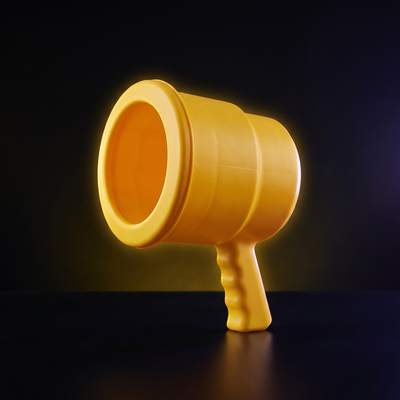
Line up paper cups on a table edge and have players knock them down from a set distance using an air vortex blaster such as an AirZooka, which fires a ring of moving air rather than anything physical. Each player gets three shots, one point per cup, and the line moves back a pace after every full round. It works indoors because nothing actually crosses the room except air.
Who Am I (10 minutes)
Write a character on a sticky note and press it on each child's back without them seeing it. They walk around asking yes or no questions of other guests to work out who they are. Cap it at three questions per person so nobody gets cornered. Anyone who guesses correctly helps the ones still working.
Ages 10 and up: longer games with a real scoring system
Older guests will accept a game that takes two minutes to explain if the payoff is worth it. They also notice when a game is beneath them, so avoid anything that looks like it was designed for a younger sibling.
Blind Drawing Relay (15 minutes)
Split into pairs. One partner sees a picture and describes it without naming the object; the other draws it. After ninety seconds, swap roles with a new picture. Score by having a neutral judge guess each drawing, one point per correct guess. Six rounds gets a proper leaderboard going.
The Category Countdown (20 minutes)
Sit in a circle. Call a category, then a letter. Going clockwise, each player names something in that category starting with that letter, with a five second limit. A repeat or a timeout loses a life, and everyone starts with three. Change the category every time someone loses a life to keep it from stalling.
Matching a game to the time you have left
| Game | Age band | Time | Energy |
|---|---|---|---|
| Sleeping Lions | 3-5 | 5 min | Calm |
| Colour Corners | 3-5 | 8 min | Active |
| Feed the Monster | 3-5 | 10 min | Moderate |
| Cup Stack Relay | 6-9 | 12 min | Active |
| Air Blast Knockdown | 6-9 | 10 min | Moderate |
| Who Am I | 6-9 | 10 min | Moderate |
| Blind Drawing Relay | 10+ | 15 min | Calm |
| Category Countdown | 10+ | 20 min | Calm |
Running times at a glance
Common problems and what to do about them
- A child refuses to join in: give them a job such as scorekeeper or timer rather than persuading them to play.
- The group splits into two camps: run one round of a game with randomly drawn teams to mix them before returning to free choice.
- Energy collapses after food: start the next game before everyone has finished eating so there is no dead gap.
- A game is clearly failing: end it after one round, announce the score, and move on without commentary.
- Too many guests for the space: split into two groups running different games and swap after ten minutes.
What to have ready before guests arrive
- Furniture pushed back and a clear play zone marked with tape or a rug edge.
- A speaker and a playlist you can pause quickly.
- Paper, pens, sticky notes and a roll of tape in one box.
- Plastic cups, rolled socks and a cardboard box, which cover most of these games.
- A written running order taped somewhere only you will look at it.
A party with four games that finish on time feels better organised than one with eight games that all overrun.