Toys with no small parts
The phrase turns up on almost every toy box and it is easy to read it as a verdict rather than a description. It is neither a guarantee nor a full picture. If your house has a toddler at floor level, a dog with an interest in dropped objects, or both at once, it helps to know exactly what the label is telling you and what it is not.
Quick answer
A toy with no small parts is one that has no component, and produces no component through normal wear, that could be swallowed. The standard warning label covers the toy as sold and as intended to be used; it does not cover what happens when a piece snaps, a battery door opens, or ammunition rolls under the sofa. Judging a toy for a mixed household means asking what it becomes after six months, not what is in the box.
Key takeaways
- The warning label describes the toy as sold, not the toy after wear.
- Ask what the toy sheds: ammunition, accessories, caps, batteries.
- Single-moulded items with sealed compartments are the safest shape.
- Toddlers and pets fail differently but the fix is largely the same.
- Where a toy is stored matters as much as what it is made of.
What the label is describing
A small parts warning is a statement about the toy in the condition it was sold, used in the way the manufacturer expected. It is based on a physical test: whether a component fits inside a defined cylinder. That is a useful, concrete thing to know. It is also narrower than most people assume when they read it.
The label does not describe what the toy becomes. It does not tell you whether the wheels stay attached after a year, whether the paint survives being chewed, or whether the battery door still closes once the screw is lost. In a household with a toddler or an animal, those questions matter more than the state of the toy on day one.
The question worth asking instead
A better framing is: what does this toy shed? Some toys shed nothing under any circumstances. Some shed by design, because ammunition and accessories are part of the concept. Some shed only when they break.
| Category | Example | What to check |
|---|---|---|
| Sheds by design | Dart blasters, bead kits, figure sets with accessories | Whether you can contain the loose pieces at all |
| Sheds on wear | Snap-on wheels, glued eyes, printed decals, clip fastenings | Whether parts are moulded in or attached |
| Sheds on damage | Hard plastic shells, painted wood, hollow bodies | Whether it breaks into fragments or splits cleanly |
| Sheds nothing | Solid balls, large bricks, air-powered toys, moulded ride-ons | Battery access, if there is any |
Three ways a toy produces small parts
Toddlers and pets fail differently
It is tempting to treat the two as one problem, but the risks are not identical and knowing the difference helps you prioritise.
- A toddler puts things in their mouth deliberately and briefly, usually while someone is nearby.
- A dog swallows things quickly and often when no one is in the room.
- A large dog can swallow objects far bigger than a toddler could, so the size threshold is different.
- Cats are less likely to swallow bulk objects and much more likely to ingest thread, ribbon and elastic.
The practical consequence is that a house with both needs the stricter of the two rules applied throughout, rather than a compromise between them.
How to judge a toy in the shop
Most of this can be done in under a minute with the box in your hands.
- Look at the contents list. Count how many separate items there are. A high count is the single strongest signal.
- Check whether wheels, eyes, caps and handles are moulded in or attached.
- Find the battery compartment and check for a screw.
- Ask whether the toy needs ammunition or consumables to work.
- Decide, before buying, where in the house this toy will be used and stored.
What genuinely qualifies
The list of toys with no small parts in any meaningful sense is shorter than the marketing suggests, but it is not short in absolute terms. Balls of every size, large-format building blocks, ride-on vehicles, scooters, soft toys with stitched features, play tunnels, parachutes, and toys that fire air rather than objects all belong on it.
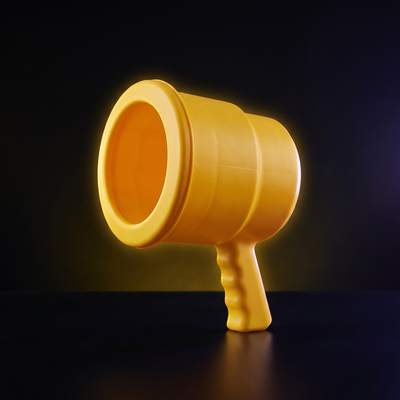
The AirZooka is an example of that last group: it fires a ring of moving air rather than a projectile, so there is no ammunition to lose and nothing to end up under the sofa. In a house with pets it should never be aimed at an animal, but as an object sitting in a cupboard it introduces nothing swallowable.
Checking what you already own
New purchases are the easy part. The toys already in the house are the ones that have had time to degrade, and they are worth a periodic look.
- Pull anything with a chewed edge, a cracked shell or a missing fastening.
- Replace lost battery screws or retire the toy.
- Reunite loose accessories with their sets, or bin them.
- Move multi-piece sets off the floor and into closed storage.
- Do the check after birthdays and holidays, when the volume of new items is highest.
Buy for the toy it will be in a year, not the toy that comes out of the box.