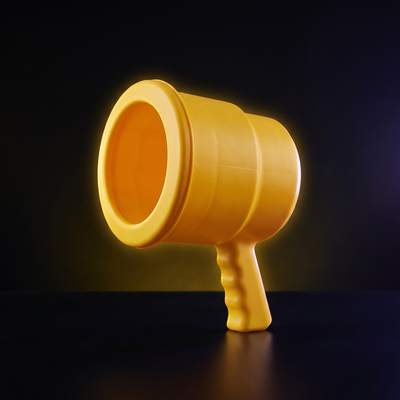
The Complete AirZooka Guide
The AirZooka looks simple, and mechanically it is. But the reason it works at all is a genuinely interesting piece of fluid dynamics, and understanding it is the difference between a toy that feels like a novelty and one that reliably knocks a paper cup off a table from across the room. This guide covers what the AirZooka actually does, what to expect from it, and how to keep it working.
Quick answer
An AirZooka is a handheld air vortex blaster. Pulling back and releasing its elastic diaphragm pushes a burst of air through the barrel, where the rim shapes it into a spinning ring of air that stays intact for roughly 15 to 20 feet indoors.
Key takeaways
- The blast is plain air shaped into a spinning ring, not a projectile
- Realistic indoor range is about 15-20 feet before the ring breaks apart
- Aim slightly high at distance, since the ring drops as it slows
- Never aim at faces, eyes or ears
- Keep the elastic diaphragm out of direct sun and store it un-stretched
How the vortex ring forms
When you release the elastic diaphragm, it snaps forward and shoves a slug of air down the barrel. Air at the centre of that slug moves faster than air scraping along the barrel wall. As the slug leaves the muzzle, the slower edge air curls backwards over the faster core, and the whole thing rolls itself into a doughnut spinning around its own circular axis.
That rotation is what makes the shot travel. A plain puff of air dissipates within a foot or two. A vortex ring carries its own momentum in a closed loop, so it holds together and pushes through still air far longer than an unstructured gust could.
What range to actually expect
Marketing numbers for air blasters are usually measured in ideal conditions. In an ordinary room, a good shot from an AirZooka will reliably move a light target at 15 feet and can still be felt at around 20. Past that the ring has entrained enough surrounding air that it grows wide, slows, and falls apart.
| Distance | What you can expect |
|---|---|
| 0-6 ft | Strong, focused blast. Will move hair and light objects easily. |
| 6-15 ft | Reliable working range. Knocks over cups and paper targets. |
| 15-20 ft | Noticeably felt, but the ring is wide and weakening. |
| 20 ft+ | Inconsistent. The ring usually breaks up before arrival. |
Typical indoor performance by distance
Aiming it well
Two habits improve accuracy more than anything else. First, pull the diaphragm back fully and release cleanly rather than easing it forward, because a partial release produces a ragged ring that dies early. Second, aim slightly above your target at distance. The ring loses speed as it travels and drifts downward on the way, so a dead-level shot at 18 feet tends to land low.
Safety and supervision
The AirZooka fires nothing but air, which removes the main hazard associated with projectile toys. The sensible limits are still worth stating: do not aim at faces, eyes or ears, especially at close range, and do not point it at pets that startle easily. Small children should use it with an adult nearby, mostly because the elastic pull-back is the part they are likely to misuse.
Care and storage
The elastic diaphragm is the only part that ages meaningfully. Heat and ultraviolet light degrade elastic, so a blaster left on a sunny windowsill or in a hot car will lose snap much faster than one kept in a cupboard. Store it with the diaphragm relaxed rather than under tension, wipe the barrel rim occasionally so it stays smooth, and check the elastic for surface cracking once a season.
Who it suits
It works best for indoor play, classroom science demonstrations, and office desk mischief. It is a poor fit for anyone expecting outdoor range, because wind ruins vortex rings almost immediately. If you want something for a garden, an air blaster is not the right category.