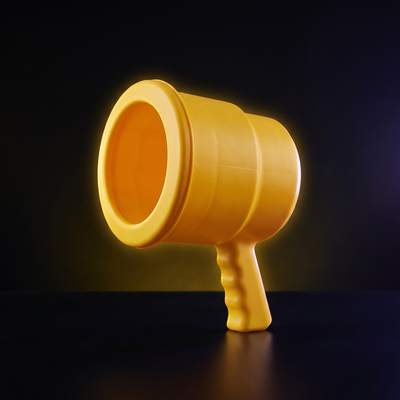
AirZooka Product Guide
There is not much to an air blaster, which is part of its appeal, but the few parts it has each do a specific job. Knowing which part is responsible for which behaviour turns troubleshooting from guesswork into a two-minute check. This guide walks through the anatomy, first setup, and the small number of faults that actually occur.
Quick answer
An AirZooka has four functional parts: the body, the elastic diaphragm, the pull handle, and the barrel rim. Almost every performance problem traces back to the diaphragm being loose, aged, or released incompletely.
Key takeaways
- Four parts do all the work: body, diaphragm, pull handle and barrel rim
- Weak shots are nearly always a diaphragm or release problem, not a body problem
- A clean, undamaged barrel rim is what shapes the ring
- No lubricants, oils or solvents anywhere near the elastic
The four parts that matter
The body is a rigid cone that holds a volume of air and keeps its shape while that air is compressed. The elastic diaphragm seals the back of that cone and provides all of the stored energy. The pull handle is bonded to the centre of the diaphragm and is how you load it. The barrel rim, the circular lip at the muzzle, is what shapes the escaping air into a ring.
Of these, the diaphragm and the rim are the two that determine performance. The body is essentially a container, and the handle is a convenience. If a shot is not behaving, the fault is almost certainly in one of the other two.
First setup
There is no assembly to speak of. Unpack it, check the diaphragm for any shipping creases and let it sit for an hour so the elastic relaxes into shape, then fire a few practice shots at a wall to get a feel for the pull. New elastic is often slightly stiffer for the first dozen shots and then settles.
Getting a clean shot
Pull the handle straight back along the axis of the body, not at an angle, and pull it to its full travel. Then release it, do not guide it forward. A guided release lets the diaphragm decelerate and produces a soft, ragged ring. The difference between a clean snap and an eased release is easily the largest single factor in shot quality.
Troubleshooting
| Symptom | Likely cause | Fix |
|---|---|---|
| Weak shots across the board | Diaphragm has lost tension | Store cooler and out of sunlight; heat-aged elastic does not recover |
| Inconsistent shot to shot | Partial or guided release | Pull fully, release cleanly |
| Ring breaks up immediately | Damaged or dirty barrel rim | Wipe the rim; check for nicks |
| Ring veers off-axis | Off-angle pull | Pull straight back along the body axis |
| No noticeable blast at all | Air leak around the diaphragm seal | Inspect the seal edge for separation |
Common symptoms and their usual cause
Cleaning and maintenance
Wipe the outer body and barrel rim with a dry cloth, or a barely damp one for stubborn marks. Keep water away from the diaphragm seal. Do not use household cleaners, alcohol, or any oil, all of which attack elastic. Store the blaster indoors, at room temperature, with the diaphragm relaxed.
What wears out and what does not
The body is effectively permanent under normal use. The diaphragm is the consumable, on a timescale of years rather than months, and its lifespan is dominated by heat and UV exposure rather than by number of shots fired. Treat storage conditions as the maintenance schedule and there is very little else to do.