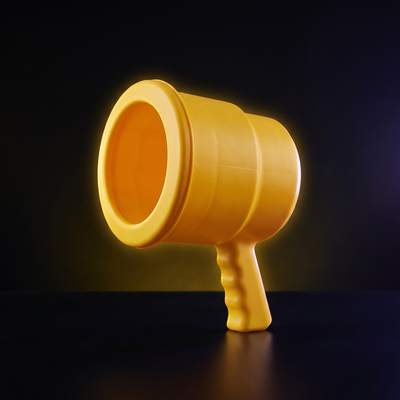
What is an air cannon toy?
Air cannons are one of the few toys that work on physics alone. Here is what they actually are, what a shot feels like, and who tends to enjoy them.
Quick answer
An air cannon toy is a handheld device that launches a fast-moving ring of air, called a vortex ring, across open space. It fires nothing solid — only air — so it can knock over lightweight objects and be felt from several metres away without any projectile.
Key takeaways
- An air cannon fires a vortex ring — a doughnut of spinning air — not a projectile
- Range depends on barrel diameter and how fast the membrane snaps forward
- Nothing solid leaves the barrel, so there is no ammunition to buy or clean up
- Most handheld models reach 6–7 metres before the ring loses shape
- They work indoors and outdoors, and need no batteries or charging
What an air cannon actually fires
The first thing to understand about an air cannon is that nothing solid ever leaves the barrel. There is no dart, no pellet, no foam ring, no compressed gas cartridge. The only thing that travels across the room is air that was already in the room a moment earlier.
What makes that air travel, rather than simply dissipating in front of you, is the shape it is forced into. When you release the elastic membrane at the back of the chamber, the whole volume of air inside is pushed forward at once. Air in the middle of the barrel moves freely. Air at the rim drags against the lip of the barrel, slows down, and curls backwards over itself.
That curling motion is the entire trick. Within a few centimetres of leaving the barrel, the puff has folded itself into a rotating doughnut of air — a vortex ring. The ring spins continuously around its own circular axis, and that rotation is what holds it together as it moves.

Why the ring travels so far
An ordinary puff of air is remarkably weak. Blow hard at a candle from two metres away and nothing happens, because the moving air immediately mixes with the still air around it and loses its energy within about a metre.
A vortex ring behaves differently because the spin gives it structure. The rotating motion means the ring carries its own small pocket of air along with it, largely sealed off from the surrounding air. Instead of mixing and stalling, it moves as a discrete object. This is the same principle behind a smoke ring, and behind the far larger vortex rings that dolphins blow underwater.
The ring does eventually break down. Friction with the surrounding air gradually slows the rotation, and as the spin weakens the ring widens and softens until it is no longer distinguishable from the air around it. On a typical handheld cannon this happens somewhere around six or seven metres.
What a shot feels like
People expect an impact and are usually surprised by how gentle it is. Being hit by a vortex ring feels like a sharp, concentrated puff of air — a soft thump on the cheek or the back of the neck, sometimes with a faint sound arriving at the same moment. It is startling rather than uncomfortable, and that gap between expectation and sensation is most of the entertainment.
The effect on objects is easier to describe precisely, because it is repeatable:
- Stacked paper or plastic cups topple reliably at four to five metres
- Loose paper on a desk scatters
- Hair visibly moves, which is why the toy works so well as a prank
- A candle flame flickers or goes out at moderate range
- Light curtains and hanging decorations sway
What it will not do is move anything with real mass. A book stays put. A mug does not slide. The force is genuine but small — concentrated enough to be felt, nowhere near enough to cause damage.
The parts that determine performance
Air cannons look simple, and mechanically they are, but a handful of design choices decide how well one performs. Understanding these makes it much easier to judge whether a particular model is worth buying.

The barrel
Barrel diameter sets the size of the ring. A wider barrel produces a larger, slower ring that is easier to hit with but carries less punch. A narrower barrel produces a tighter, faster ring with better range and a more noticeable impact. The lip at the front edge matters too: a clean, smooth rim forms a cleaner vortex than a rough or uneven one.
The membrane
This is the elastic sheet at the back of the chamber, and it is the component that does the work. When you pull it back and release, its snap forward is what displaces the air. Membrane tension is the single biggest factor in how hard a cannon hits. It is also the part that wears out first, since it is the only component under repeated stress.
The chamber volume
A deeper chamber holds more air and produces a fuller ring. This is why very small novelty air cannons feel weak: there simply is not enough air in the chamber to form a ring that survives more than a metre or two.
| Design factor | Increases range | Trade-off |
|---|---|---|
| Narrower barrel | Yes | Smaller target area, harder to aim |
| Higher membrane tension | Yes | Requires more hand strength to cock |
| Larger chamber | Yes | Bulkier, heavier to hold steady |
| Smooth barrel lip | Yes | Depends on manufacturing quality |
How the main design variables trade off against one another.
How air cannons compare to other toys
The closest categories are foam dart blasters and water guns, and the differences are practical rather than subtle.
| Air cannon | Foam blaster | Water gun | |
|---|---|---|---|
| Ammunition | None — uses ambient air | Darts, must be collected | Water, must be refilled |
| Indoor use | Yes | Usually | No |
| Cleanup | None | Collecting darts | Drying surfaces |
| Running cost | None | Replacement darts | None |
| Power source | Manual | Manual or battery | Manual or battery |
The practical differences that tend to matter most day to day.
The absence of ammunition is the defining advantage. There is nothing to lose under the sofa, nothing to buy again in three months, and nothing to tidy up afterwards. It is also what makes air cannons usable in places where a foam dart would be unwelcome — offices, classrooms, and rooms with breakable things in them.
Who air cannons suit
They tend to work best in three situations. The first is households with children old enough to aim sensibly, roughly six and upwards, where the lack of projectiles removes most of the usual parental objections.
The second is workplaces. An air cannon is quiet, leaves no trace, and the effect at four or five metres is subtle enough to be genuinely confusing for whoever is on the receiving end.
The third is teaching. Vortex rings are a clean demonstration of air pressure, momentum and fluid motion, and a handheld cannon makes an abstract idea immediately physical. Adding fog to the chamber makes the ring visible, which turns it into a genuinely memorable classroom demonstration.
The appeal is not force. It is the gap between seeing nothing leave the barrel and feeling something arrive.
Why the toy keeps working on people
What to consider before buying
If you have decided an air cannon is the right kind of toy, a few things separate a good one from a disappointing one:
- Build quality of the barrel. A rigid barrel that holds its shape forms better rings than thin, flexible plastic.
- Membrane replaceability. The membrane wears out eventually; a model that lets you replace it lasts far longer.
- Grip and cocking action. You will fire it hundreds of times, so an awkward grip or an overly stiff pull becomes tiring quickly.
- Size relative to the user. A cannon sized for an adult is often too large for a young child to cock properly, which makes it feel weak.
- What comes in the box. Target cups are a small addition but they make the first few minutes considerably more fun.
Most of these are visible from a product listing if you know to look. Barrel rigidity and membrane quality are the two that most often separate a toy that stays in use from one that ends up in a cupboard.