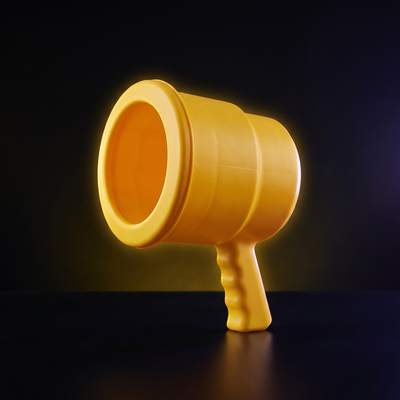
How air cannons work
The mechanism is simple enough to explain in a paragraph, but the physics behind it is the same fluid dynamics that produces smoke rings and dolphin bubble rings.
Quick answer
An air cannon works by pushing a chamber of air forward all at once. Air at the barrel rim drags and curls backwards, folding the puff into a spinning doughnut called a vortex ring. That rotation holds the air together, letting it travel several metres instead of dispersing immediately.
Key takeaways
- The membrane snapping forward displaces the air — there is no motor or compressed gas
- Drag at the barrel rim is what creates the spin
- Rotation stops the air mixing with the room, which is why it travels
- Range ends when friction slows the spin and the ring widens
- Adding fog to the chamber makes the ring visible
The moment of firing
Pulling the membrane back stores elastic energy. Releasing it drives the membrane forward, and the entire volume of air inside the chamber is pushed towards the barrel opening at once.
What happens next is decided at the barrel rim. Air in the centre of the opening leaves unobstructed. Air touching the rim is slowed by friction against the edge, so it lags behind, and the faster air in the middle rolls over it. Within a few centimetres the puff has folded into a rotating ring.
Why spin makes it travel
A vortex ring is self-sustaining in a way a plain puff is not. Because it rotates continuously around its own circular axis, it carries a pocket of air with it and stays largely sealed from the room. Instead of mixing and stalling, it moves forward as a discrete object.
What limits the range
Friction never stops acting on the ring. As rotation slows, the ring widens and slows with it. Force falls off gradually rather than stopping suddenly, which is why the practical range is a band rather than a hard number.
The same physics elsewhere
Vortex rings are not unique to toys. Smokers produce them with smoke, dolphins blow them underwater to play with, and volcanoes occasionally emit enormous ones from circular vents. In every case the mechanism is identical: fluid pushed through a round opening, curling at the edge.
That is also why an air cannon works so well as a teaching aid. It makes an invisible and fairly abstract piece of fluid dynamics immediately physical.