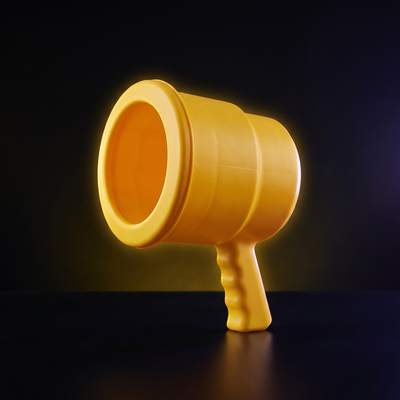
What air cannons are made of
There are only two materials that matter in an air cannon, and they have opposite lifespans.
Quick answer
Most air cannons use a moulded rigid plastic shell and barrel, with a natural or synthetic rubber membrane at the rear. The shell effectively lasts forever; the rubber membrane is the wearing part and determines the practical lifespan of the toy.
Key takeaways
- Rigid moulded plastic is used for the shell because it holds the barrel round
- The membrane is rubber because it needs high elastic recovery
- Rubber is the only component that genuinely ages
- Heat and UV are what degrade the membrane, not use alone
- Replaceable elastics effectively remove the lifespan limit
The shell and barrel
These are almost always injection-moulded rigid plastic, typically polypropylene or a similar commodity polymer. The requirements are straightforward: light enough to hold at arm's length, rigid enough not to flex when air rushes past, and cheap enough to mould in volume.
Rigidity is the property that actually affects performance. A barrel that flexes even slightly on firing produces an out-of-round opening, and an out-of-round opening produces a ragged vortex ring that breaks up early.

The membrane
The membrane needs high elastic recovery — it has to return to its original shape instantly, hundreds of times, without gradually stretching. Natural rubber and synthetic equivalents do this better than any plastic film, which is why every design uses one.
That choice has a consequence. Rubber ages, and it ages faster in heat and sunlight than it does from being used. A cannon fired daily but stored in a cupboard will outlast one fired occasionally but left on a sunny windowsill.
| Component | Typical material | Wears out? |
|---|---|---|
| Shell and barrel | Moulded rigid plastic | Effectively never |
| Membrane | Natural or synthetic rubber | Yes — the limiting part |
| Tension bands | Rubber | Yes — usually replaceable |
| Handle | Moulded plastic | No |
Only the rubber components have a finite life.
What this means when buying
Because the shell outlasts the rubber by a wide margin, the most useful durability feature is not a tougher shell but a replaceable band. It converts the toy from something with a fixed lifespan into something you can keep indefinitely for the cost of an elastic.