What Is a Vortex Ring?
Most moving air goes nowhere in particular. Wave a hand and you stir up a mess of eddies that fade within a few centimetres. Yet a smoke ring can cross a room, and a dolphin can blow a ring of air that hangs in the water long enough for it to swim through. The difference is structure. This article explains what that structure is, how it forms, and why the same shape turns up in a volcano vent and in a human heart.
Quick answer
A vortex ring is a ring-shaped region of fluid — air, water or smoke — that rotates continuously around its own circular core, like a doughnut turning itself inside out. That rotation wraps the ring in its own moving fluid, so it holds together and carries momentum much further than a loose puff would. Blow out a candle from across a room and you have almost certainly made one without seeing it.
Key takeaways
- A vortex ring is a doughnut of fluid rotating around its own circular core.
- The rotation is what keeps it intact; a plain puff of air disperses within inches.
- Rings form whenever fluid is pushed sharply through an opening.
- They appear in dolphin play, volcanic vents, smoke rings and blood flow in the heart.
- Rings slow and widen as they travel, then break up into ordinary turbulence.
The shape, described plainly
Picture a doughnut sitting flat in mid-air. Now imagine the dough itself turning: the outer surface rolls forward over the top, down the front, back underneath and up through the hole again. Every part of the ring is moving, but the ring as a whole holds its form and drifts steadily forward. That is a vortex ring, and physicists call the shape a toroidal vortex.
The hole in the middle is not empty. Fluid is being drawn through it constantly, which is what feeds the rotation. This is why a ring appears to pull air along behind it, and why a second ring launched into the wake of the first often behaves oddly, speeding up or passing through.
How a ring forms at an edge
Vortex rings are made at edges. When a slug of fluid is pushed quickly through a round opening, the fluid in the middle of the opening moves fastest and the fluid touching the rim is slowed by friction. That mismatch makes the flow curl back on itself at the rim, all the way round the circle at once. The curl closes into a ring, detaches from the opening and travels on under its own momentum.
Three things have to be true for a clean ring. The opening should be roughly circular. The push should be short and sharp rather than a steady stream, because a continuous jet produces a chaotic plume instead of a discrete ring. And the surrounding air should be reasonably still.
| Condition | Why it matters | What happens without it |
|---|---|---|
| Circular opening | Lets the curl close evenly all the way round | A lopsided ring that wobbles and collapses early |
| Short, sharp push | Separates one slug of fluid from the rest | A continuous jet, which fans out into a plume |
| Still surroundings | Nothing drags the ring off course | Draughts tear the ring apart within a metre or two |
| Smooth rim | Keeps friction even around the edge | Local snags seed turbulence that eats the ring |
What each condition does
Why rotation buys distance
A puff of air with no rotation is just a region of fast-moving fluid sitting next to slow-moving fluid. The two mix almost immediately, and the puff is gone. A vortex ring avoids this because its rotation continually rolls the boundary fluid around the core rather than shearing against it. The ring behaves less like a gust and more like a self-contained object.
That does not make it permanent. Viscosity — the internal friction of the fluid — steadily bleeds off the spin. As it does, the ring grows wider and travels more slowly, which is the pattern anyone who has watched a smoke ring will recognise.
Where vortex rings show up in nature
Dolphins and whales
Dolphins in aquaria are well known for blowing rings of air underwater and then playing with them, swimming through the hole or splitting a ring into two. Humpback whales use a related trick for feeding, releasing curtains and rings of bubbles that herd fish into a tight ball.
Volcanoes
Some volcanic vents produce steam rings, most famously at Etna and Stromboli. The vent acts as the circular opening and a sudden gas release supplies the push. The rings can be tens of metres across and hold together for a surprisingly long time in still air.
Smoke rings and mushroom clouds
A smoke ring from a puff of the lips is the classic example. At the other extreme, the rising cap of a large explosion is a vortex ring on an enormous scale: hot gas rises, curls at its own edges and rolls into the familiar doughnut shape beneath the mushroom head.
Inside the human heart
When blood is pushed through the mitral valve into the left ventricle, it forms a vortex ring. Cardiologists study the shape and strength of that ring because a heart that is not filling well tends to produce a disorganised one.
Making rings on purpose
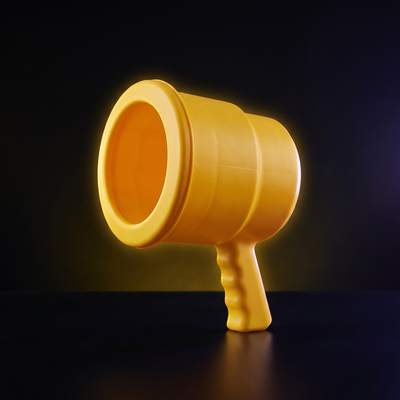
Devices that launch air rings all follow the same recipe: a chamber with a round hole and a way to hit the air sharply. A cardboard box with a hole cut in one face and the opposite face left open works well — strike the open back with a flat hand and a ring leaves the hole. Purpose-built launchers such as the AirZooka use an elastic diaphragm to give a cleaner, more repeatable push, which is why the rings hold together over a longer distance.
- Aim slightly above your target; rings drift downward a little as they slow.
- Fire across a still room rather than into a draught or an open window.
- Add a visible marker — fog or vapour — if you want to watch the ring rather than just feel it.
- Fire single sharp pulses, not repeated rapid ones, so each ring has clear air to travel through.
The short version
A vortex ring is what happens when fluid is pushed through a hole and the edge of that hole makes the flow curl back on itself. The resulting rotation gives the parcel of fluid a structure that ordinary puffs lack, so it travels, holds shape and behaves almost like a solid object until friction finally wins. Once you know the shape, you start seeing it everywhere: in a candle blown out across a table, in a dolphin tank, above a volcano, and in the flow of blood through a beating heart.