Science Fair Projects About Air
The most common mistake in an air-themed science fair entry is presenting a demonstration as if it were an experiment. Crushing a bottle with cooling air is impressive, but on its own it answers no question. The projects below all start from something you can measure with a ruler, a stopwatch or a kitchen scale, and each is framed as a question with a variable attached.
Quick answer
A science fair project about air needs more than a demonstration: it needs one variable you deliberately change, one you measure, and everything else held steady. Good options include testing how launch-hole diameter affects the distance an air ring travels, how temperature changes the pressure inside a sealed bottle, or how wing shape changes glide distance. Each of the seven below is written as a question with a measurable answer.
Key takeaways
- A demonstration shows something; an investigation measures how one variable changes another.
- Name the independent, dependent and controlled variables before you build anything.
- Run every condition at least three times and report the spread, not just the average.
- State a hypothesis with a direction and a reason, not just a guess.
- Air projects are cheap, which leaves time for repeat trials — judges notice repeat trials.
Turning a topic into an investigation
Before choosing a project, get the structure clear. The independent variable is the one thing you change on purpose. The dependent variable is what you measure. The controlled variables are everything you deliberately keep the same so that the comparison means something. If you cannot name all three in one sentence, the project is still a demonstration.
| Topic | As a demonstration | As an investigation |
|---|---|---|
| Air pressure | Crush a bottle with cold water | Does water temperature change how much the bottle crushes? |
| Air rings | Fire a ring across the room | Does hole diameter change how far the ring travels? |
| Flight | Throw a paper aeroplane | Does wing width change glide distance from a fixed height? |
| Drag | Drop a paper helicopter | Does blade length change the time taken to fall two metres? |
The same topic, demonstration versus investigation
Project 1: Does hole size change how far an air ring travels?
Build identical cardboard air cannons and cut a different hole diameter in each — say 4 cm, 8 cm, 12 cm and 16 cm. Fire each at a row of light paper cups placed at half-metre intervals and record the furthest cup knocked over.
- Independent variable: hole diameter.
- Dependent variable: furthest distance at which the ring topples a target.
- Controlled: box size, force of the strike, room, target weight, height of the launcher.
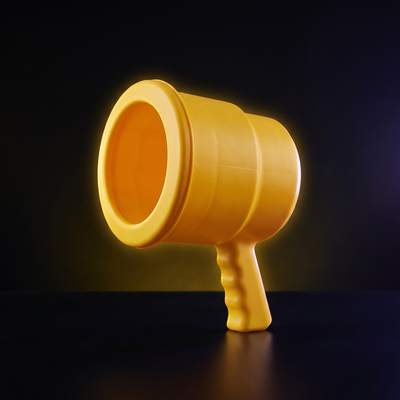
The hardest control is the strike. A weight dropped from a fixed height onto the back panel gives a far more consistent push than a hand, and judges reward that kind of thinking. A manufactured launcher such as an AirZooka can serve as a consistency benchmark to compare your homemade cannons against.
Project 2: Does temperature change the pressure in a sealed container?
Seal a balloon over the neck of a glass bottle and place the bottle in water baths at several temperatures. Measure the balloon's circumference with a tape at each temperature after a fixed settling time.
- Independent variable: water bath temperature.
- Dependent variable: balloon circumference in centimetres.
- Controlled: bottle, balloon, settling time, room temperature, how the tape is placed.
Hypothesis: circumference will rise as temperature rises, because warming air expands and pushes outward. Plot temperature against circumference and the shape of that line is your result.
Project 3: Does wing area change glide distance?
Fold paper gliders from identical sheets, varying only the wing width. Launch each from a fixed height using a ramp or a launcher rather than by hand, and measure the horizontal distance travelled.
The value of this project is that it forces you to confront launch consistency. Hand-throwing introduces more variation than the effect you are trying to measure, so building a repeatable launcher is half the work — and worth explaining on the board.
Project 4: Does surface texture change how fast an object falls?
Drop identical coffee filters, some left smooth and some crumpled to different degrees, from a fixed height and time the fall with a stopwatch or a phone's slow-motion video.
- Independent variable: degree of crumpling, defined by the diameter of the crumpled shape.
- Dependent variable: fall time in seconds.
- Controlled: filter mass, drop height, still air, timing method.
Slow-motion video is more reliable than a thumb on a stopwatch, and saying so in your method shows you thought about measurement error.
Project 5: How far does a straw rocket fly at different launch angles?
Make a paper rocket that slides over a straw and blow it using a fixed-volume push — a syringe or a second bottle squeezed to a marked point rather than lungs, which vary. Test angles from 15 to 75 degrees in steps and measure landing distance.
Hypothesis: distance will peak somewhere near the middle of the range, because a shallow launch gives little air time and a steep one gives little forward travel. Finding where the peak actually sits is the result.
Project 6: Does humidity change how visible an air ring is?
Using a fog machine or a cool-mist humidifier as the visible marker, photograph rings against a dark background and measure how far along their path they remain identifiable in the images. Vary the density of the vapour in the launch chamber.
This project scores well because the measurement is genuinely awkward and you must define your own criterion for 'visible' — for example, the last frame in which the ring's hole can be distinguished. Stating that definition clearly is exactly what judges want to see.
Project 7: Does a paper helicopter's blade length change its descent time?
Cut paper helicopters from identical card with blade lengths of 4, 6, 8 and 10 cm. Drop each from the same height and time the descent over several trials.
Expect longer blades to fall more slowly up to a point, then to become unstable. Finding and describing that turning point makes a much stronger conclusion than a simple straight-line trend.
Writing up so the work counts
Record raw numbers, not just averages, and show the spread across trials — a range or a set of bars tells the reader how confident to be. Describe what went wrong as well as what worked; an honest account of a failed control reads as competence, not weakness. Finish with what you would change next time, and keep the conclusion within what your numbers actually support.