How to Explain Air Pressure to a Child
Air pressure is difficult to explain not because the physics is hard but because the substance is invisible and the effect is constant. A child has never experienced its absence, so there is no contrast to point at. The way through is to make air feel like a material first, then show a situation where the usual balance is broken and something obvious happens. What follows is a progression by age, with wording that works and wording that quietly causes trouble later.
Quick answer
Start from the two ideas everything else rests on: air is made of stuff, and that stuff pushes on everything from every side at once. For a five-year-old, that is a crowded room of people gently bumping into you. For a nine-year-old, add that the push is balanced, so we only notice it when something breaks the balance. Demonstrate before explaining — a child who has felt the push has something for the words to attach to.
Key takeaways
- Establish that air is a substance before mentioning pressure at all.
- The idea children most often miss is that air pushes sideways and upward too.
- Avoid saying that something 'sucks' — it teaches a wrong mechanism that has to be unlearned.
- Let the child feel or see the effect first, then supply the explanation.
- Older children can handle that a pressure difference, not a vacuum, does the work.
Step one: air is a thing
No explanation of pressure will land until the child accepts that air is a material and not simply the absence of material. Two demonstrations do this quickly.
- Push an upturned clear cup straight down into a bowl of water and let them see the water stop at the rim. Tilt it and let the air bubble out, and the water rushes in.
- Have them wave a folded piece of card at their face. What they feel is not nothing — it is air being moved.
Once a child says 'the air is in the way', the foundation is in place. Do not introduce the word pressure before this point.
Ages 5 to 7: the crowded room
At this age the aim is a feeling, not a definition. The analogy that works: imagine a room so full of people that they are gently bumping into you all the time — on your back, your front, your head, your sides. Air is like that, made of pieces far too small to see, bumping into everything from every direction.
That immediately answers the question every child asks, which is why we do not feel it. The bumps come from all sides at once and cancel out, and there are people bumping from the inside too.
Language that works at this age: 'air pushes'. Language to avoid: 'sucks', 'pulls', 'vacuum'. Keep the demonstrations physical — a balloon squeezed, a cup pushed into water, a ring of air fired across the room from a cardboard cannon.
Ages 8 to 10: the balance and how to break it
By this age a child can hold two ideas at once, which is what the topic needs: the push exists everywhere, and things only move when the push is stronger on one side than the other.
Introduce it with the straw. Put a straw in a drink and ask what happens when you drink. The instinct is 'I pull it up'. Correct it gently: what you actually do is take some air out of the straw, so there is less push inside it than on the surface of the drink outside, and the outside air pushes the liquid up the straw.
Then show the same idea in reverse. Cover the top of a straw with a fingertip, lift it out of the water and the liquid stays. Uncover it and the water falls. Nothing changed except whether air could push down from above.
| Situation | What children say | What is happening |
|---|---|---|
| Drinking through a straw | I suck it up | Less push inside the straw, so outside air pushes the drink up |
| A plunger sticking to a sink | It sucks onto the surface | Air pushed out from underneath, so outside air holds it down |
| A crushed plastic bottle | It got squashed by itself | The air inside cooled and pushed less, so outside air won |
| Ears popping on a plane | My ears blocked | Outside pressure changed and the air inside had not caught up |
Same idea, three familiar situations
Ages 11 to 12: weight, height and numbers
Older children can take the next step: the push exists because there is a column of air above them, several kilometres deep, and it has weight. That makes two things follow naturally.
- Pressure falls with altitude, because there is less air above you on a mountain than at sea level.
- Pressure changes with weather, because moving air masses pile up or thin out the column overhead — which is what a barometer measures.
This is also the age at which to connect pressure and temperature: heating air makes its pieces move faster and push harder, which is why a sealed bottle crumples as it cools and why a balloon left in the sun grows.
Demonstrations matched to age
| Age | Demonstration | Idea it carries |
|---|---|---|
| 5-7 | Cup pushed into water | Air is real and takes up space |
| 5-7 | Air ring fired across a room | Moving air can push things at a distance |
| 8-10 | Finger over a straw | Sealing removes the push from one side |
| 8-10 | Upside-down glass with a card | Air pushes upward as well as down |
| 11-12 | Bottle crushed by cooling | Temperature changes pressure |
| 11-12 | Balloon on a bottle in warm water | Warmed air expands measurably |
What to show, and when
Air pressure at a distance
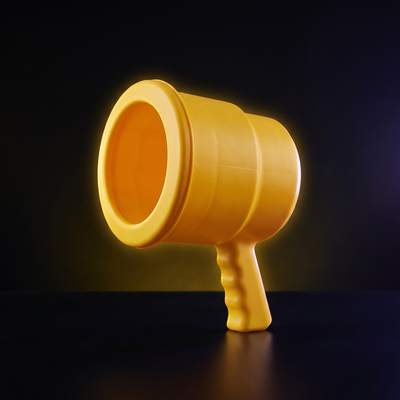
One question that reliably follows is how moving air can affect something across a room. The answer is a good bridge from pressure into fluid behaviour: when air is pushed sharply through a round hole, it can roll into a spinning ring that holds together and travels metres. An air launcher such as an AirZooka, or a cardboard box with a hole cut in it, makes the point instantly — the child sees a target move with nothing visible touching it.
Answering the hard follow-ups
'Why doesn't it crush me?'
Because you are not empty. Air fills your lungs and your body's fluids push outward, so the pushes balance. Things get crushed only when the push on one side drops — which is exactly what happens to the sealed bottle.
'Is there air pressure in space?'
Almost none, because there is almost no air. That is a useful contrast to offer, since it shows the pressure comes from the air itself rather than being a property of space.
'Why do my ears pop?'
There is air behind the eardrum. When the outside pressure changes quickly, the two sides no longer match and the eardrum bulges until a small tube lets air move and equalise. The pop is that moment of balance returning.
Checking the explanation landed
Ask a prediction question rather than a definition question. 'If I make a hole in the bottom of this bottle, what will happen when you blow the balloon up inside it?' A child who can reason about that has understood the idea. One who can recite that air pressure is force per unit area may not have.