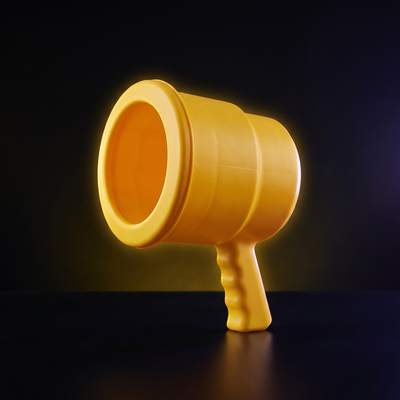
Air Cannons: A Beginner's Guide
Air cannons sound implausible until you see one work. There is no ammunition, no compressed gas cylinder, and no motor, yet a well-aimed shot will knock a stack of cups off a table from across the room. If you have just picked one up, or are deciding whether to, this covers the basics in the order they actually matter.
Quick answer
An air cannon fires a spinning ring of ordinary air. Nothing solid leaves the barrel. Pull the elastic back fully, release it cleanly, aim a little high at distance, and keep it pointed away from faces.
Key takeaways
- Nothing solid is fired — the projectile is a spinning ring of air
- A full pull and a clean release matter more than aiming
- Expect a reliable 15-20 feet indoors, much less outdoors
- Light targets like paper cups make the best practice
- Never aim at faces, eyes or ears
What an air cannon actually fires
The projectile is a vortex ring: a doughnut of air rotating around its own circular axis. It forms as air rushes out of the barrel, with the slower air at the edges curling back over the faster air in the middle. That rolling motion is the whole trick. Unstructured puffs of air die within a foot; a rotating ring carries its momentum in a closed loop and keeps going.
Your first ten shots
Set a paper cup on a table about eight feet away. Grip the body, pull the elastic handle straight back to its full travel, and let go without guiding it forward. If the cup moves, you have the technique. If it does not, the release is almost always the culprit, not the aim.
Once that works consistently, move the cup back in two-foot increments. You will find the distance at which your shots stop landing, and that is the practical working range for your particular cannon and technique.
Range expectations
Indoors, expect a well-formed ring to work reliably out to about fifteen feet and to be noticeable at twenty. Beyond that the ring has widened and slowed to the point where it usually disintegrates before arriving. Outdoors, halve that at best, and in any real wind it will not work at all.
Aiming
Rings travel along the barrel axis, so pointing the cannon is most of the aiming. The one correction worth learning is elevation: as the ring slows it drifts downward, so at longer distances aim slightly above your target. At close range, aim directly.
Safety basics
Because nothing solid is fired, air cannons avoid the main risk of projectile toys. The rules that remain are short. Do not aim at faces, eyes or ears, particularly close up. Do not point one at a pet that startles easily. Do not attempt to load anything into the barrel, which is both unsafe and damaging to the diaphragm. Younger children should have an adult nearby, mainly because the elastic pull-back invites misuse.
Where to go from here
Once the basics are comfortable, the interesting part is setting up targets that reward accuracy: cup pyramids, suspended paper strips, or a candle at the far end of a hallway. All of these give immediate feedback on whether your ring survived the trip, which is the only real skill involved.