Air Pressure Experiments for Kids
Air pressure is one of the few science topics where the demonstrations are genuinely startling and the equipment costs nothing. A child who has watched a glass of water stay upside down on a piece of card has a physical memory that no diagram provides. The eight experiments below have been chosen because they are reliable, use household items, and each shows a distinct aspect of how air behaves.
Quick answer
The best air pressure experiments for children use ordinary kitchen items and show a visible result within a minute or two: a balloon that refuses to inflate inside a sealed bottle, a glass of water held upside down by a piece of card, an egg pulled into a bottle by cooling air. Each one works because air has weight and pushes in every direction, and the experiment sets up a difference in that push. The eight below are ordered from simplest to most involved.
Key takeaways
- Air pushes in every direction, not just downward.
- Most of these experiments work by making the pressure inside a container differ from outside.
- Heating and cooling air changes its pressure, which drives several of the classics.
- Nearly everything needed is already in a kitchen.
- Ask children to predict the outcome before each attempt — that is where the learning happens.
Before you start
Air has weight and it pushes on everything from all sides at once. We do not notice because the push is balanced: the same amount is pressing on the inside of a container as on the outside. Every experiment below works by breaking that balance, and the visible result is the air moving to restore it. Ask for a prediction before each one; a wrong prediction is more useful than a right one.
- A tray or towel underneath — two of these involve water.
- Adult supervision for anything using hot water or a flame.
- A notebook for predictions and results if you want it to count as a project.
1. The balloon that will not inflate
Push a deflated balloon into an empty plastic bottle and stretch its neck back over the bottle mouth. Ask a child to blow it up. They cannot get far.
- Take a clean, dry plastic bottle with no holes.
- Drop the balloon inside and fold the opening over the bottle's rim to seal it.
- Blow hard. The balloon expands a little, then stops.
- Now drill or poke a small hole in the base of the bottle and repeat.
The principle: the bottle is already full of air. With no way out, that trapped air is compressed and pushes back on the balloon as hard as the child is pushing. Give the trapped air an escape route and the balloon inflates normally.
2. The upside-down glass of water
Fill a glass right to the brim, lay a piece of stiff card over the top, press it flat, hold it in place and invert the glass over a sink. Let go of the card. The water stays put.
The principle: atmospheric pressure pushing up on the underside of the card is far greater than the weight of the water pushing down. Surface tension seals the edge and stops air from sneaking in. Fill the glass only halfway and it fails, because the trapped air above the water now pushes down as well.
3. The egg in a bottle
A peeled hard-boiled egg sits on the neck of a glass bottle, too wide to fall through. Warm the air inside the bottle, then set the egg on top, and the egg is drawn in whole.
- Hard-boil and peel an egg. Use a bottle whose mouth is slightly narrower than the egg.
- An adult pours hot water into the bottle, swirls it to warm the air, and tips it out.
- Set the egg on the mouth immediately, narrow end down.
- Watch as the air inside cools over the next minute.
The principle: warm air expands and some escapes past the egg. As the remaining air cools it contracts and its pressure drops, so the atmosphere outside pushes the egg through the neck. To get the egg out again, tip the bottle so the egg blocks the mouth and blow in hard, then let go.
4. The collapsing bottle
An adult pours a little hot water into a plastic bottle, swirls it, tips it out and screws the cap on tight. Run the bottle under cold water and it crumples on its own.
The principle: this is the egg experiment without the egg. The hot water fills the bottle with warm, expanded air and vapour. Sealing and cooling it drops the internal pressure, and the atmosphere crushes the bottle inward.
5. The straw pipette
Dip a drinking straw into water, cover the top with a fingertip and lift. Water stays in the straw. Lift the finger and it drops out.
The principle: with the top sealed, air can only push up from the bottom, and that push holds the small column of water in place. Open the top and the air pushes down as well, restoring the balance so gravity wins.
6. The plunging cup
Push an upturned clear cup straight down into a bowl or sink of water. Slip a folded paper towel into the bottom of the cup first, and it comes out dry.
The principle: the cup is full of air, and air takes up space. Water cannot enter until that air has somewhere to go. Tilt the cup slightly and you can watch bubbles escape and water take their place.
7. The rising water and the candle
Stand a short candle in a shallow dish of coloured water, light it, and place a tall glass over it. When the flame goes out, water climbs into the glass.
The principle: this one is commonly explained as oxygen being used up, but the main driver is temperature. The flame heats the air, which expands and escapes; once the flame dies the trapped air cools and contracts, and outside pressure pushes water up to fill the gap. Adult supervision is essential.
8. The air cannon
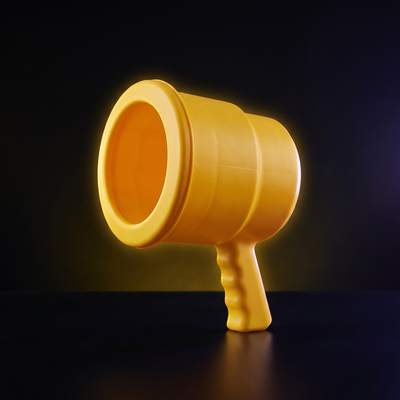
Cut a round hole in one face of a cardboard box, leave the opposite face open, and strike that open face with a flat hand. A ring of air leaves the hole and can knock over a paper cup several metres away. A purpose-made launcher such as an AirZooka does the same thing with a stretched diaphragm and a cleaner push.
The principle: a sharp increase in pressure inside the box forces air out through the hole. Friction at the rim curls the escaping air into a spinning ring, which holds together far better than a loose puff and so travels across a room.
| Experiment | Main principle | Adult help needed |
|---|---|---|
| Balloon in a bottle | Trapped air resists compression | Only for the hole |
| Upside-down glass | Atmospheric pressure pushes upward | No |
| Egg in a bottle | Cooling air contracts | Yes |
| Collapsing bottle | Cooling air contracts | Yes |
| Straw pipette | Sealing removes the downward push | No |
| Plunging cup | Air occupies space | No |
| Candle and water | Heated air expands and escapes | Yes |
| Air cannon | Pressure difference drives airflow | No |
Which experiment shows what
Turning an experiment into an investigation
Any of these becomes a proper piece of science the moment you change one thing and measure the result. Does water temperature change how far the egg is drawn in? Does card thickness affect whether the upside-down glass holds? Keep everything else the same, run each version at least three times, and write the numbers down before deciding what they mean.