Educational Physics Toys
Plenty of toys are labelled educational because a principle is mentioned on the box. The ones worth having are different: the behaviour that makes them interesting is the physics itself, so a child who plays with one long enough starts asking the right question without being prompted. This is a look at the classics and what each genuinely demonstrates — including a few where the standard explanation is not quite right.
Quick answer
An educational physics toy earns the label when the thing that makes it fun is also the thing that makes it physics. A Newton's cradle shows conservation of momentum and energy in collisions, a gyroscope shows angular momentum and precession, a Cartesian diver shows buoyancy and the compressibility of gas, and a vortex cannon shows how rotation lets a parcel of fluid hold its shape. Toys where the principle is hidden inside a sealed mechanism teach much less.
Key takeaways
- The best physics toys let the mechanism be seen, not just its effect.
- Newton's cradle demonstrates momentum and energy conservation together — either alone gives the wrong prediction.
- A gyroscope's resistance to being turned is angular momentum, and its slow wander is precession.
- A Cartesian diver responds to pressure because the gas inside it is compressible and the water is not.
- Ask a child to predict, then to explain the gap between prediction and result.
What separates a teaching toy from a novelty
A good test: can a child change one thing about how they use the toy and get a different, predictable result? A Newton's cradle passes because lifting two balls instead of one changes the outcome in a way that can be reasoned about. A toy with a button and a light does not, because nothing the child does alters what happens inside.
The second test is visibility. Where the working parts are exposed — the spinning wheel, the rising diver, the ring of air crossing a room — the child has something to observe and argue about.
Newton's cradle: collisions, not magic
Five steel balls hang in a line, just touching. Lift one and release it, and one ball flies out at the far end. Lift two, and exactly two leave. The behaviour looks like the cradle is counting, which is what makes it worth explaining.
Two quantities are conserved in these near-elastic collisions: momentum and kinetic energy. Momentum alone would permit two balls to leave slowly when one arrives fast. Energy alone would permit other combinations too. Only the outcome that satisfies both at once is possible, and that outcome is the same number of balls leaving at the same speed as arrived.
- Lift two balls and predict before releasing — most people guess wrong the first time.
- Point out that it slows and stops. Energy is leaving as sound, heat and air resistance.
- Try slipping a soft material between two balls to see the collision become inelastic.
Gyroscopes: angular momentum you can feel
A spun gyroscope resists being tilted, and when you push it anyway it turns slowly about a different axis instead. That resistance is angular momentum, and the sideways wander is precession.
The reason to own a physical one rather than watch a video is that resistance is a felt thing. Holding a spinning bicycle wheel by its axle and trying to tip it gives a sensation there is no substitute for, and it is the same effect that keeps a bicycle upright and a spinning top standing.
Cartesian diver: pressure and buoyancy together
A small sealed object with an air bubble floats in a closed plastic bottle of water. Squeeze the bottle and it sinks; release and it rises. The classic homemade version uses a sauce sachet or a pen lid weighted with modelling clay.
Squeezing raises the pressure throughout the water, which is nearly incompressible and simply passes the pressure on. The air bubble inside the diver is compressible, so it shrinks. A smaller bubble displaces less water, the diver's buoyancy drops below its weight, and it sinks. Release the bottle and everything reverses.
Vortex cannons: fluid dynamics you can aim
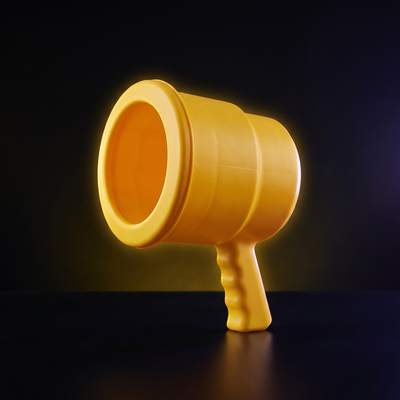
A vortex cannon pushes air sharply through a round opening and launches a spinning ring that travels several metres and can move a light target. The interesting part is not the range but the reason for it: a plain puff of air disperses within inches, while a rotating ring carries its own boundary with it and holds together.
That makes it one of the few toys demonstrating fluid dynamics rather than mechanics, which is otherwise a hard field to make tangible. Both homemade cardboard cannons and manufactured launchers such as the AirZooka work on the same principle; the manufactured version mainly buys consistency, which matters if you are comparing shots.
The rest of the shelf
Spinning tops and tippe tops
An ordinary top shows angular momentum in the simplest possible form. A tippe top goes further: spin it and it flips over to stand on its stem, because friction with the surface converts its spin into a different orientation. It is one of the few toys whose behaviour still surprises people who understand it.
Magnet kits
Field lines drawn out in iron filings, and the pushback felt between two like poles, make an invisible field into something with a shape and a direction. Worth having, though the principle is closer to demonstration than investigation.
Balancing birds and tightrope figures
These show centre of mass. The bird balances on its beak because weights in the wingtips put the centre of mass below the contact point. Adding a coin to one wing and watching it fail teaches more than the toy working does.
Hand boilers and drinking birds
Both use a volatile liquid and a temperature difference to drive motion. The drinking bird in particular is a working heat engine, though the mechanism is sealed in glass and needs explaining rather than observing.
| Toy | Principle demonstrated | Variable to play with |
|---|---|---|
| Newton's cradle | Conservation of momentum and energy | Number of balls lifted |
| Gyroscope | Angular momentum and precession | Spin speed before tilting |
| Cartesian diver | Buoyancy; pressure in an enclosed fluid | Amount of trapped air |
| Vortex cannon | Vortex formation in fluids | Hole diameter and push strength |
| Tippe top | Friction and rotational stability | Surface roughness |
| Balancing bird | Centre of mass | Extra weight on one wing |
Toy, principle, and what to change
Getting the most out of any of them
Ask for a prediction before every attempt, and treat a wrong one as the useful outcome. Change one thing at a time so the comparison means something. Let the toy fail occasionally — an overloaded balancing bird or a cradle winding down teaches more than a demonstration that always works. And resist supplying the vocabulary too early; a child who can reliably predict what a gyroscope will do has understood angular momentum, whether or not they can name it.